
PCIe 6.0 SSDs Are Finally Arriving: What Next-Generation Storage Means for Gaming PCs and NVMe Buyers
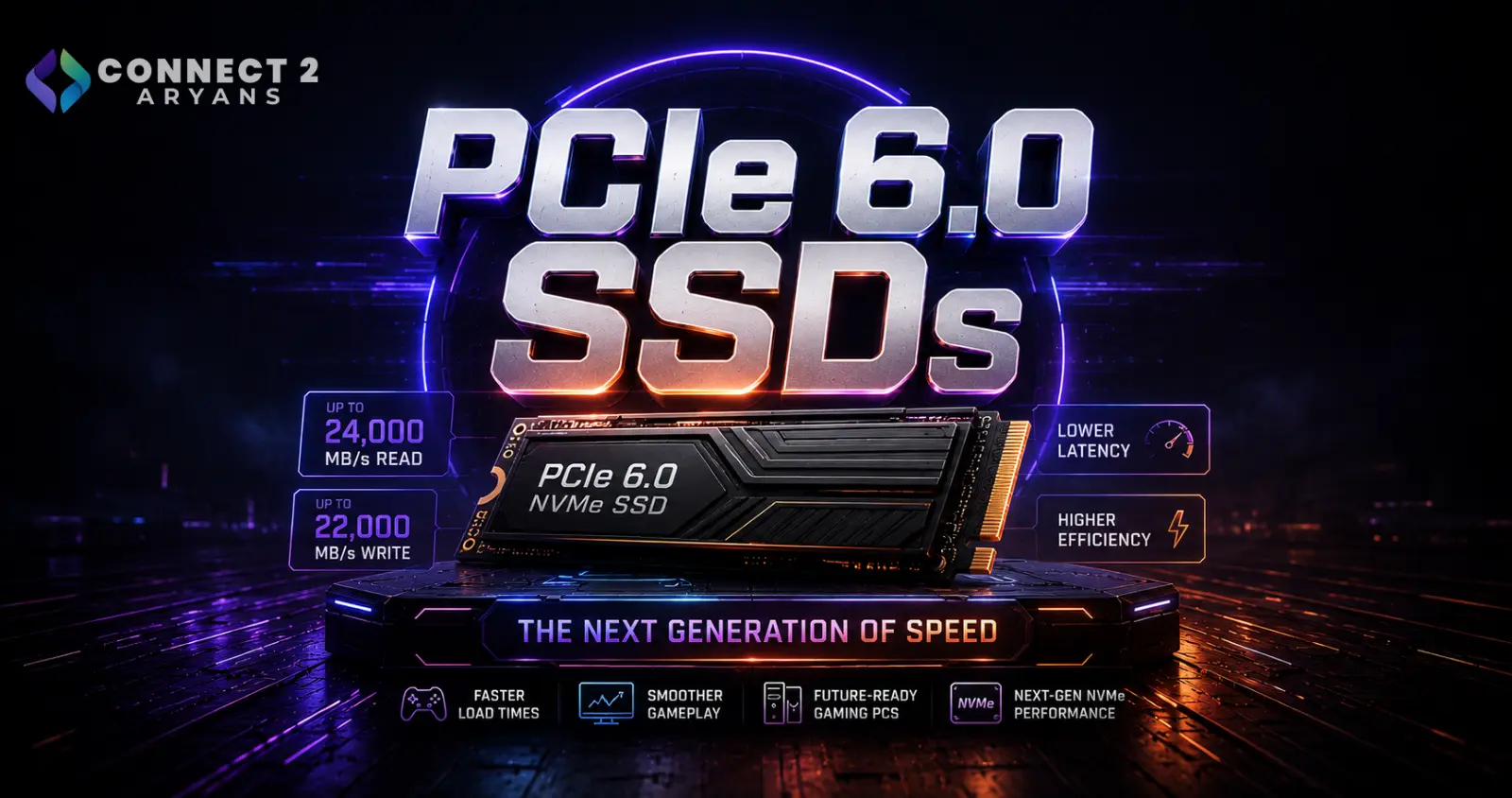
PCIe 6.0 SSDs Are Finally Arriving: What Next-Generation Storage Means for Gaming PCs and NVMe Buyers
Just as PCIe 5.0 NVMe SSDs are becoming established in high-end consumer PCs, the storage industry is already preparing for another major jump.
PCIe 6.0 SSDs are now becoming real products.
Samsung announced on July 8, 2026 that it had begun mass production of its PM1763, a PCIe 6.0 enterprise SSD designed for AI and high-performance computing infrastructure.
Meanwhile, storage-controller manufacturers including Marvell, Phison and Silicon Motion are preparing PCIe 6.0 controller platforms as the industry moves toward broader Gen6 SSD adoption.
That doesn't mean you should delay your gaming-PC build and wait for a PCIe 6.0 M.2 SSD.
Quite the opposite.
The first PCIe 6.0 products are heavily focused on servers, AI infrastructure and enterprise workloads rather than ordinary gaming desktops.
But the transition matters because it shows where PC storage is heading next—and it raises an important question for buyers in Pakistan:
If PCIe 6.0 is already arriving, is it still worth buying PCIe 4.0 or PCIe 5.0 storage today?
The answer is yes.
Understanding why requires looking beyond the generation number.
PCIe 6.0 Storage Has Moved Beyond the Concept Stage
PCIe 6.0 itself isn't a brand-new specification.
The specification was finalized years ago, but creating processors, controllers, motherboards and SSDs capable of reliably operating at those speeds takes considerably longer.
The important development in 2026 is that actual storage products are now reaching production.
Samsung's PM1763 is one of the clearest examples.
Samsung describes the PM1763 as a PCIe 6.0-based enterprise SSD optimized for next-generation AI and HPC server environments.
The drive uses Samsung's:
- Ninth-generation V-NAND
- 4nm SSD controller
- PCIe 6.0 interface
- Enterprise-oriented architecture
Samsung specifically positions it for demanding AI workloads rather than consumer gaming PCs.
That's an important distinction.
PCIe Generations Explained
PCI Express is the high-speed interconnect used by many PC components.
That includes:
- Graphics cards
- NVMe SSDs
- Network cards
- Expansion cards
- Accelerators
Each major PCIe generation increases the available data-transfer capability.
For storage buyers, the progression has looked roughly like:
PCIe 3.0 NVMe
↓
PCIe 4.0 NVMe
↓
PCIe 5.0 NVMe
↓
PCIe 6.0 NVMe
A newer generation provides more potential bandwidth.
But potential bandwidth and real-world application performance are not the same thing.
That's one of the most important concepts when choosing an SSD.
PCIe 6.0 Doubles the Raw Data Rate Again
PCIe 6.0 operates at 64 GT/s per lane, doubling the raw transfer rate of PCIe 5.0.
For an x4 connection—the configuration commonly associated with high-performance NVMe SSDs—that provides enormous potential bandwidth.
This continues the familiar PCIe progression:
PCIe 4.0 → 16 GT/s per lane
PCIe 5.0 → 32 GT/s per lane
PCIe 6.0 → 64 GT/s per lane
However, PCIe 6.0 introduces more than simply a faster signaling rate.
It changes how data is transmitted.
PCIe 6.0 Uses PAM4 Signaling
Earlier PCIe generations primarily used NRZ signaling.
PCIe 6.0 introduces PAM4, or Pulse Amplitude Modulation with four levels.
Rather than representing data using only two voltage states, PAM4 allows more information to be transmitted within each signaling interval.
This helps PCIe 6.0 achieve its enormous bandwidth increase.
But faster signaling creates engineering challenges.
Signal integrity becomes more difficult.
Controllers become more complex.
Power efficiency matters more.
PCB design becomes more demanding.
That's one reason why new PCIe generations don't immediately appear in mainstream consumer PCs as soon as the specification is finalized.
PCIe 6.0 Also Introduces FLIT Mode
Another major architectural change is FLIT mode.
PCIe 6.0 uses fixed-size Flow Control Units to improve efficiency and reliability at extremely high transfer rates.
Combined with Forward Error Correction, the technology helps maintain reliable data transmission despite the challenges introduced by PAM4 signaling.
These changes are largely invisible to an ordinary PC user.
You won't open Windows and select:
Enable FLIT Mode.
Instead, they're part of the underlying architecture that allows future components to operate reliably at much higher bandwidth.
Samsung's PM1763 Shows What Gen6 Can Do
Samsung's PM1763 provides an early indication of the performance PCIe 6.0 storage can deliver.
Samsung says the drive can achieve sequential read performance of up to:
14.8 GB/s
with random read performance reaching:
3.3 million IOPS.
Samsung also says the PM1763 delivers up to 20% better power efficiency compared with its previous-generation PCIe 5.0 enterprise SSD.
Those are substantial figures.
But there is something important to notice.
This isn't simply a gaming SSD with a new interface.
It's an enterprise drive specifically optimized for AI and HPC infrastructure.
Why Are PCIe 6.0 SSDs Starting With AI Servers?
Because AI infrastructure can actually use enormous storage bandwidth.
Large AI systems continuously move massive datasets between:
- Storage
- System memory
- GPUs
- Accelerators
- CPUs
Storage can become a serious bottleneck.
Samsung specifically cites growing data volumes required for AI training and inference as a reason increasingly capable enterprise SSDs are needed.
In these environments, saving even small amounts of time across huge datasets can matter.
That's very different from loading a game level several seconds faster.
AI Is Accelerating Storage Development
Graphics cards aren't the only components being transformed by AI demand.
AI infrastructure is putting pressure on almost every part of the computer:
GPU performance
Memory capacity
Memory bandwidth
Networking
Storage bandwidth
Power delivery
Cooling
That creates enormous demand for faster enterprise storage.
The first PCIe 6.0 SSDs therefore make far more sense inside expensive AI servers than inside an ordinary gaming desktop.
Eventually, however, technology developed for high-end infrastructure tends to move down-market.
We saw the same pattern with earlier PCIe generations.
Samsung Isn't the Only Company Preparing PCIe 6.0 Storage
The ecosystem is expanding.
Tom's Hardware reported on August 13, 2026 that major independent SSD-controller manufacturers are preparing PCIe 6.0 platforms.
These include:
Marvell
Phison
and
Silicon Motion.
This is significant because consumer SSD manufacturers don't all design their own controllers.
Many build drives around controller platforms supplied by specialist companies.
When companies such as Phison and Silicon Motion develop Gen6 controllers, it creates the foundation for a much broader range of future PCIe 6.0 SSDs.
Why SSD Controllers Matter
An SSD isn't simply NAND flash connected directly to PCIe.
The controller is effectively the brain of the drive.
It manages tasks including:
- Reading and writing NAND
- Error correction
- Wear leveling
- Garbage collection
- Cache management
- Host communication
- Thermal behavior
A faster interface therefore isn't enough by itself.
The controller and NAND must be capable of feeding data quickly enough to make use of that interface.
This is why a drive being labeled:
PCIe 6.0
doesn't automatically tell you its actual performance.
The same principle already applies to PCIe 4.0 and PCIe 5.0 drives.
Interface Generation Is Not an SSD Performance Rating
This deserves emphasis.
Two SSDs can both support:
PCIe 4.0 x4
while delivering very different performance.
Likewise, two future PCIe 6.0 SSDs may perform very differently.
The interface tells you the maximum communication capability.
The drive's actual performance depends on:
- Controller
- NAND
- Firmware
- DRAM
- Cache design
- Capacity
- Cooling
- Workload
So don't buy an SSD based solely on the PCIe generation printed on the box.
We Already See This With PCIe 4.0 SSDs
Connect2Aryans' current NVMe catalogue provides a good real-world example.
The live storage category includes multiple PCIe Gen4 x4 NVMe SSDs with different performance levels.
For example, the XPG GAMMIX S60 BLADE 1TB is a PCIe Gen4 x4 drive rated for sequential reads up to 5,000 MB/s.
Meanwhile, the XPG GAMMIX S70 BLADE 1TB also uses PCIe Gen4 x4 but is rated for sequential reads up to 7,400 MB/s.
Same PCIe generation.
Very different maximum sequential performance.
That's why buyers should compare the actual SSD rather than simply:
Gen4 vs Gen4.
Browse NVMe SSDs on Connect2Aryans
PCIe 5.0 Is Already Available for Consumer PCs
While PCIe 6.0 begins its enterprise rollout, PCIe 5.0 is the more relevant cutting-edge technology for today's enthusiast PC builders.
Connect2Aryans currently lists the Samsung 9100 PRO 2TB, a consumer M.2 2280 NVMe SSD using a PCIe Gen5 x4 interface.
View Samsung 9100 PRO 2TB PCIe 5.0 NVMe SSD on Connect2Aryans
That demonstrates the current consumer-storage hierarchy clearly:
PCIe 4.0 → mainstream high-performance NVMe
PCIe 5.0 → current enthusiast/high-end consumer NVMe
PCIe 6.0 → beginning primarily in enterprise and AI infrastructure
Do Gamers Need PCIe 6.0?
No.
Not today.
And importantly:
Most gamers don't even need PCIe 5.0 purely for gaming performance.
Modern PCIe 4.0 NVMe drives are already extremely fast.
A high-performance Gen4 drive such as the WD_BLACK SN850X 2TB listed on Connect2Aryans is rated for sequential reads up to 7,300 MB/s and writes up to 6,600 MB/s.
View WD_BLACK SN850X 2TB on Connect2Aryans
That's already vastly beyond SATA storage bandwidth.
For gaming, storage requirements aren't simply a race toward the largest sequential-read number.
Faster SSD Does Not Automatically Mean More FPS
This is one of the most common misunderstandings about gaming storage.
A faster SSD can improve things such as:
- Game loading
- Level transitions
- Asset streaming
- Installation
- File copying
- System responsiveness
But it generally does not behave like a graphics-card upgrade.
Moving from:
PCIe 4.0 → PCIe 5.0
doesn't mean your game suddenly gets dramatically higher FPS.
Likewise:
PCIe 5.0 → PCIe 6.0
won't automatically transform gaming performance.
The game engine has to generate storage workloads capable of benefiting from the additional bandwidth.
Why PCIe 4.0 Remains the Gaming Sweet Spot
PCIe 4.0 NVMe storage remains extremely capable for modern gaming.
It provides enough bandwidth for:
- Fast boot times
- Modern AAA games
- DirectStorage-capable systems
- Content creation
- Large file transfers
- Everyday workstation use
It is also supported across a huge number of modern desktop and laptop platforms.
For many PC builders, spending more money on:
additional SSD capacity
can be more useful than spending that money purely to move to a newer interface generation.
Capacity Still Matters More Than Benchmark Bragging Rights
Imagine choosing between:
1TB extremely fast SSD
and
2TB fast SSD
for a gaming library.
If both drives already provide sufficient real-world gaming performance, the larger drive may deliver a much better everyday experience.
Modern games can consume enormous amounts of storage.
A faster benchmark doesn't help if you constantly need to uninstall games because the SSD is full.
This is why storage decisions should balance:
Speed + Capacity + Price + Compatibility
rather than focusing on one number.
PCIe 5.0 Still Makes Sense for Enthusiasts
There are plenty of legitimate reasons to buy PCIe 5.0 today.
It can make sense if you:
- Build a flagship PC
- Move very large files
- Edit high-resolution video
- Work with large datasets
- Use professional applications
- Want maximum available consumer storage performance
- Already have a motherboard with appropriate Gen5 M.2 support
In those situations, PCIe 5.0 isn't just about gaming.
It's about overall workstation and storage performance.
PCIe 6.0 Will Initially Matter Much More to Professionals
The first Gen6 storage wave is particularly relevant to:
AI servers
Data centers
High-performance computing
Enterprise storage
Cloud infrastructure
rather than home gaming.
Samsung's own PM1763 announcement explicitly positions the drive for next-generation AI and HPC server environments.
That should prevent consumers from misinterpreting the current news.
PCIe 6.0 SSDs arriving does not mean your PCIe 4.0 gaming SSD is suddenly outdated.
Enterprise SSDs Are Very Different From Consumer M.2 Drives
When most PC users hear “SSD,” they picture something like:
M.2 2280 NVMe drive
installed directly onto a motherboard.
Enterprise storage can look very different.
Enterprise drives prioritize things such as:
- Sustained workloads
- Reliability
- Power-loss protection
- High endurance
- Serviceability
- Server compatibility
- Consistent latency
- Large-scale deployment
Samsung's PM1763 is designed around those priorities.
It shouldn't be directly compared with an ordinary gaming M.2 drive simply because both use NVMe technology.
Heat Will Be a Major Challenge for Future Gen6 Consumer SSDs
Storage performance isn't free.
Higher-performance controllers can consume more power and generate more heat.
We've already seen this become important with PCIe 5.0 consumer SSDs.
Many modern high-end motherboards include increasingly substantial M.2 heatsinks specifically to manage fast NVMe drives.
PCIe 6.0 raises the engineering challenge further.
Future consumer Gen6 controllers will need to balance:
Performance
Power
and
Thermals
carefully if manufacturers want to fit them into compact M.2 devices.
Cooling Could Become Part of the SSD Buying Decision
Years ago, SSD cooling barely entered the conversation for ordinary PC builders.
Today, high-performance M.2 heatsinks are common.
With future drives, users may need to pay even more attention to:
- Motherboard M.2 heatsinks
- Thermal pads
- Airflow
- Controller temperatures
- Drive throttling
A theoretically faster SSD isn't useful if it continuously reduces its speed because of excessive heat.
This is another reason the transition to newer PCIe generations takes time.
PCIe 6.0 Motherboards Aren't the Consumer Standard Yet
Buying a PCIe 6.0 SSD also requires a platform capable of providing the appropriate interface.
Today's mainstream consumer systems are still primarily built around PCIe 4.0 and PCIe 5.0 connectivity.
That means a future Gen6 consumer SSD will only deliver its intended interface performance when paired with a compatible platform.
The storage ecosystem therefore has to develop together:
CPU
Chipset
Motherboard
SSD controller
NAND
before Gen6 becomes mainstream.
PCIe Is Designed With Backward Compatibility in Mind
One useful characteristic of PCI Express is generational compatibility.
A newer PCIe device can often operate in an older compatible slot, but it will be limited by the capabilities of that interface.
This is already relevant today.
Installing a PCIe 4.0 NVMe SSD into a system that only provides PCIe 3.0 connectivity may allow the drive to function, but it cannot operate at full Gen4 interface performance.
The same principle will matter with future Gen6 storage.
Always check motherboard documentation before buying.
What Should You Buy for a Gaming PC in 2026?
For most gaming PCs, the hierarchy remains straightforward.
Budget or Older System
A SATA SSD or affordable PCIe 3.0 NVMe drive can still provide a huge improvement over an HDD.
Mainstream Gaming PC
A quality PCIe 4.0 NVMe SSD remains an excellent choice.
High-End Gaming and Creator PC
A high-performance PCIe 4.0 or PCIe 5.0 NVMe SSD can make sense depending on workload and budget.
AI Server or Enterprise System
This is where PCIe 6.0 is beginning to become relevant.
The important point is:
Buy for your actual workload, not for the newest generation number.
Connect2Aryans Already Offers Storage Across Different Performance Levels
The live Connect2Aryans NVMe category currently includes more than 50 NVMe storage products, covering multiple capacities, form factors and PCIe generations.
Browse NVMe SSDs on Connect2Aryans
Examples currently indexed on the store include PCIe Gen3 and Gen4 models, while the Samsung 9100 PRO represents the newer PCIe Gen5 class.
That allows buyers to choose according to the PC they actually own rather than paying for bandwidth their platform cannot use.
PCIe 4.0 Options Still Cover a Huge Performance Range
For example, Connect2Aryans currently lists the Crucial T500 1TB, a PCIe Gen4 NVMe M.2 drive rated for sequential reads up to 7,300 MB/s and writes up to 6,800 MB/s.
View Crucial T500 1TB on Connect2Aryans
The XPG GAMMIX S70 BLADE 1TB is another Gen4 option, rated for sequential reads up to 7,400 MB/s.
View XPG GAMMIX S70 BLADE 1TB on Connect2Aryans
Those figures illustrate just how capable existing consumer Gen4 storage has become.
SATA SSDs Aren't Dead Either
The arrival of PCIe 6.0 doesn't make SATA SSDs useless.
Connect2Aryans continues to list 2.5-inch SATA SSDs for systems where NVMe isn't available or where affordable secondary storage is the priority.
Browse SATA SSDs on Connect2Aryans
For an older laptop or desktop still using a mechanical hard drive, moving to SATA SSD storage can produce a much more noticeable everyday improvement than worrying about the difference between PCIe 5.0 and PCIe 6.0.
Context matters.
Should You Wait for PCIe 6.0 Before Building a PC?
For most consumers:
No.
Waiting for PCIe 6.0 consumer storage makes little sense if you need a PC today.
The technology is only beginning to emerge commercially, with the current focus heavily centered on enterprise and AI infrastructure.
Current PCIe 4.0 and PCIe 5.0 SSDs are already extremely fast.
And by the time consumer Gen6 drives become widespread, you'll also need a platform capable of using them properly.
Technology never stops advancing.
Waiting for the next interface generation can become an endless cycle.
What Pakistani PC Buyers Should Consider
For buyers in Pakistan, component value is particularly important because local hardware pricing is affected by factors including:
- Exchange rates
- Import costs
- Distributor stock
- International supply
- Product availability
Buying the newest storage generation simply because it exists may therefore provide poor value.
Instead, ask:
Does my motherboard support this drive?
Will my applications benefit from the additional speed?
Do I need more capacity instead?
Could the same budget improve my GPU, CPU or RAM?
Am I paying for performance I will actually use?
Those questions produce better PC builds than chasing specification-sheet records.
PCIe 6.0 Is Still Important Even If You Don't Need It
There's a difference between:
“You need PCIe 6.0.”
and
“PCIe 6.0 matters.”
Most gaming-PC owners don't need it today.
But the technology matters because it increases the ceiling for future storage performance.
AI and enterprise systems will push the technology first.
Controller development will improve.
Power efficiency will improve.
Platforms will gain support.
Eventually, the technology can move toward enthusiast and mainstream consumer hardware.
That's the same process we've watched with previous PCIe generations.
Frequently Asked Questions
What is a PCIe 6.0 SSD?
A PCIe 6.0 SSD is a solid-state drive using the sixth generation of the PCI Express interface. PCIe 6.0 operates at 64 GT/s per lane and provides substantially greater potential bandwidth than PCIe 5.0.
Are PCIe 6.0 SSDs available in 2026?
Yes, PCIe 6.0 storage has entered commercial production in the enterprise market. Samsung announced mass production of its PM1763 PCIe 6.0 enterprise SSD on July 8, 2026.
Is Samsung's PM1763 a gaming SSD?
No. Samsung specifically designed the PM1763 for AI and HPC server environments. It is an enterprise SSD rather than a conventional consumer gaming M.2 drive.
How fast is Samsung's PCIe 6.0 PM1763?
Samsung states that the PM1763 can deliver sequential read speeds up to 14.8 GB/s and random read performance up to 3.3 million IOPS.
Do I need PCIe 6.0 for gaming?
No. PCIe 4.0 NVMe storage already provides excellent performance for modern gaming, while PCIe 5.0 represents the current high-end consumer option.
Is PCIe 5.0 outdated now that PCIe 6.0 exists?
No. PCIe 6.0 is only beginning its rollout, primarily in enterprise and AI infrastructure. PCIe 5.0 remains a current high-performance consumer technology.
Should I buy PCIe 4.0 or PCIe 5.0 for gaming?
For most gaming PCs, a good PCIe 4.0 NVMe SSD remains an excellent balance of performance and practicality. PCIe 5.0 becomes more attractive for high-end builds and professional workloads that can make use of additional storage bandwidth.
Will PCIe 6.0 increase gaming FPS?
A faster storage interface doesn't automatically increase GPU rendering performance. Storage can affect loading and asset streaming, but gaming FPS is primarily influenced by components such as the GPU and CPU.
Can a newer PCIe SSD work in an older PCIe slot?
PCIe is designed around backward compatibility, but a drive operating through an older-generation interface will be limited by the capabilities of that connection. Always verify compatibility with your motherboard manufacturer.
Where can I compare NVMe SSDs in Pakistan?
Browse NVMe SSDs on Connect2Aryans
The live category currently includes more than 50 NVMe products across multiple capacities and PCIe generations.
Conclusion
PCIe 6.0 SSDs have finally started moving from future technology into real commercial hardware.
Samsung began mass production of its PM1763 PCIe 6.0 enterprise SSD in July 2026, targeting next-generation AI and HPC infrastructure with sequential reads up to 14.8 GB/s and as many as 3.3 million random-read IOPS.
At the same time, controller specialists including Marvell, Phison and Silicon Motion are preparing their own PCIe 6.0 storage platforms, helping establish the ecosystem required for wider Gen6 adoption.
But PC gamers shouldn't interpret this as a reason to abandon current storage.
PCIe 6.0's first major use case is AI and enterprise infrastructure, where enormous datasets and high-performance servers can actually exploit the additional bandwidth.
For ordinary gaming PCs in 2026, PCIe 4.0 remains an excellent mainstream NVMe choice, while PCIe 5.0 serves enthusiasts and professional users who want higher storage performance.
The most important lesson is the same regardless of generation:
Don't buy an SSD based only on the PCIe number.
Consider the drive's actual performance, capacity, controller, NAND, cooling requirements, motherboard compatibility and—most importantly—your workload.
PCIe 6.0 represents the future of high-performance storage.
But a good PCIe 4.0 or PCIe 5.0 SSD remains very much part of the present.
Browse NVMe SSDs on Connect2Aryans
View Samsung 9100 PRO 2TB on Connect2Aryans
Browse SATA SSDs on Connect2Aryans
Browse our full range of storage devices on Connect2Aryans, with warranty support included.