
Microsoft Quietly Deleted Its 32GB RAM Advice — Right After Launching 8GB Surfaces
Microsoft Quietly Deleted Its 32GB RAM Advice — Right After Launching 8GB Surfaces
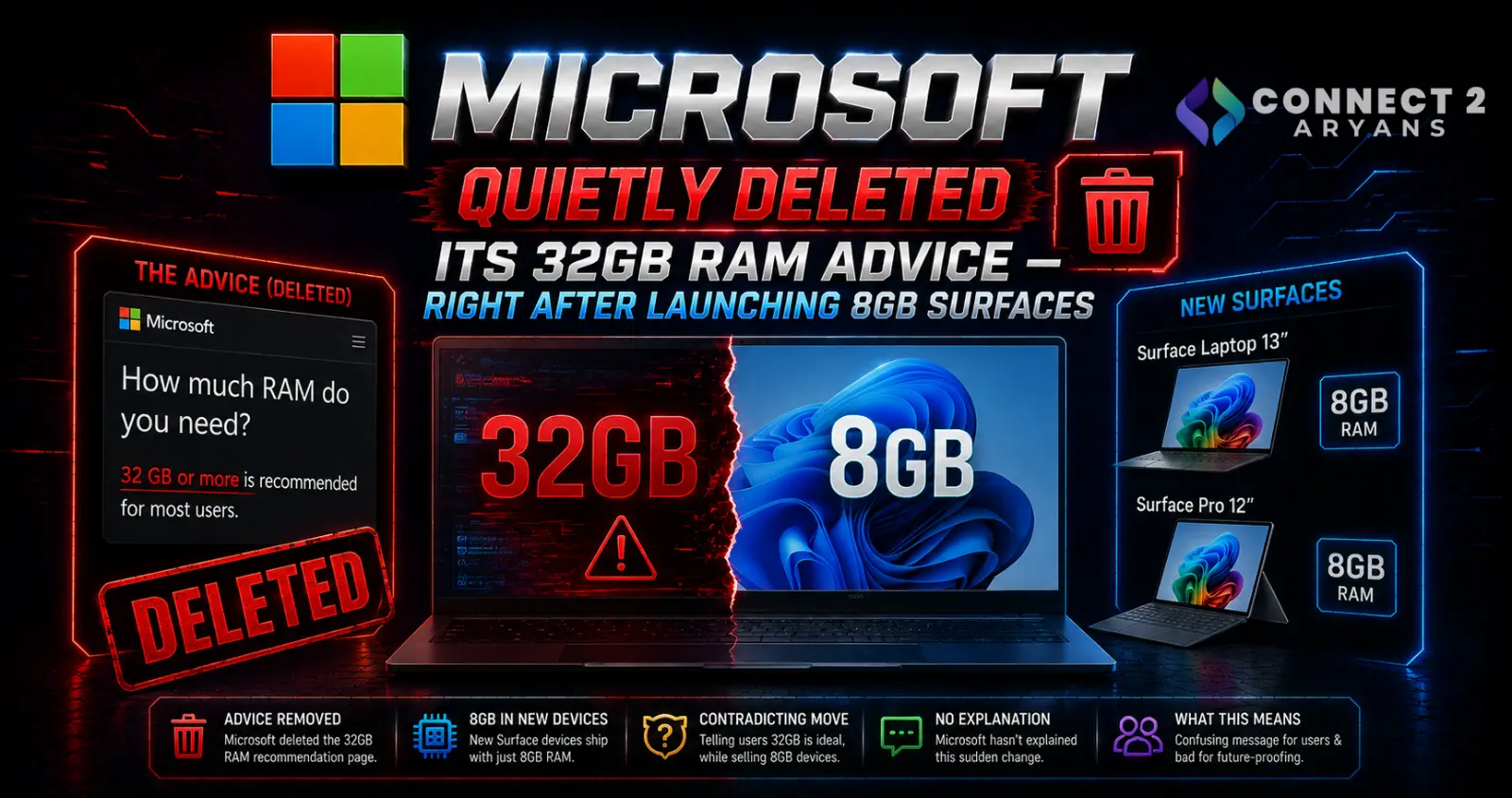
Not long ago, Microsoft was telling PC gamers that 32GB of RAM was the "no worries" amount for a smooth Windows 11 experience. That guidance has now quietly disappeared from Microsoft's own website — for the second time in 2026 — right as the company begins selling Surface devices with just 8GB of RAM. Here's the full timeline, and what it actually means for your own RAM decisions.
What Actually Happened
Microsoft has now deleted two separate Windows Learning Center articles that recommended 32GB of RAM for gaming, without any public explanation for either removal:
- The first deletion happened in May 2026, after gamers reacted strongly on tech forums and social media to Microsoft calling 32GB the "no worries" upgrade at a time when RAM prices were already climbing sharply
- A second, related article — published in November 2025 and describing 32GB as "ideal for serious players who run the most demanding titles or use heavy mods" — was also deleted, with both original URLs now redirecting to the general Windows Learning Center homepage
- Microsoft has not officially explained either removal, though the original page content remains accessible through the Internet Archive's Wayback Machine
Why the Timing Looks Bad for Microsoft
The deletions coincide directly with Microsoft's own hardware decisions:
- In June 2026, Microsoft launched the Surface Pro 12-inch and Surface Laptop 13-inch with 8GB RAM base configurations, starting at $849 and $949 respectively
- Neither of these base configurations qualifies as a Copilot+ PC — Microsoft's own AI-focused branding standard, which still requires a 16GB minimum — meaning Microsoft is now selling Surface hardware that fails its own marketing bar
- Upgrading the Surface Pro 12-inch from 8GB to 16GB costs an additional $200 — working out to $25 per gigabyte, on the very same store where Microsoft had recently been recommending 32GB as ideal
- By late June, Surface product pages had shifted to describing 8GB RAM as "great for everyday use like browsing, streaming, schoolwork, and productivity apps" — a striking reversal from language that had spent most of the past year pointing serious users toward 32GB
Microsoft's Actual Explanation (Sort Of)
Microsoft hasn't directly addressed why the guidance was deleted, but the company has been more forthcoming about a related, ongoing effort: reducing how much memory Windows 11 itself consumes. Windows engineering leader Pavan Davuluri confirmed in late July 2026 that Microsoft is working to make Windows 11 more memory-friendly, with footprint improvements targeting general availability by the end of 2026.
Much of Windows 11's memory overhead comes down to how it's built — large parts of the interface run on web-based technologies like React and WebView2, and a significant share of popular Windows apps are Electron-based wrappers around web code rather than lean native applications, both of which consume more RAM than older, simpler approaches.
The Bigger Picture: This Is the Same Memory Crisis, From a New Angle
This isn't an isolated Microsoft decision — it's a direct consequence of the same AI-driven global memory shortage that's been reshaping RAM, SSD, and GPU pricing all year. DRAM manufacturers have redirected production capacity toward far more profitable AI data center memory, leaving less consumer-grade supply available and pushing prices up sharply. Samsung, one of the three major DRAM manufacturers, has publicly described the memory supply outlook as heading toward a "severe" crisis in 2027, with visibility beyond 2029 described as genuinely unclear.
Microsoft isn't alone in adjusting its stance under this pressure, either — AMD, which spent years telling gamers to look toward GPUs with more VRAM, recently released the Radeon RX 9050 with just 4GB of VRAM, a notable reversal of its own prior guidance.
Is 8GB Actually Enough Now?
This is genuinely the practical question worth answering, separate from the corporate messaging story:
- 8GB remains tight for anything beyond basic browsing, schoolwork, and light productivity — it's workable for very light use, but multitasking, gaming, and heavier software will feel constrained
- 16GB remains the practical, comfortable minimum for most current PC use, including moderate gaming and everyday multitasking — this hasn't fundamentally changed just because Microsoft removed a webpage
- 32GB is still genuinely useful for serious gamers, streamers, and multitaskers — Microsoft's original advice wasn't wrong on the technical merits; what changed is that recommending it became commercially awkward once RAM prices made 32GB expensive and Microsoft's own hardware moved toward 8GB base configurations
- Microsoft's planned Windows memory-footprint improvements, once they actually ship, may modestly ease how far 8GB or 16GB stretches — but they don't change the fundamental relationship between RAM capacity and how smoothly multitasking and demanding software perform
What This Means for Your Own Buying Decisions
- Don't take a company's marketing language as a reliable guide to your actual needs — Microsoft's own recommendation shifted based on business convenience, not new technical findings about how much RAM Windows genuinely requires
- Match RAM capacity to your actual use case, not to whatever a manufacturer currently finds easiest to sell — light use can reasonably get by on 8-16GB, but gaming, multitasking, and creative work still benefit meaningfully from more
- If you're shopping for a laptop or pre-built PC right now, check the actual RAM specification carefully rather than assuming a familiar price point still includes the same configuration it did a year ago
Final Thoughts
Microsoft quietly deleting its own 32GB RAM guidance — twice — right as it launches 8GB Surface devices, is a clear example of marketing messaging bending to commercial pressure created by the broader memory crisis, not a genuine technical reassessment of how much RAM people actually need. The practical guidance hasn't really changed: 16GB remains the sensible everyday minimum, and 32GB still helps if you game seriously or multitask heavily — regardless of what any one company's website currently says.
Browse our full range of Memory RAM on Connect2Aryans, and Laptops with RAM configurations that actually match your needs, with warranty support included.