
What Is HUDIMM? The New "Cheaper DDR5" Memory Explained
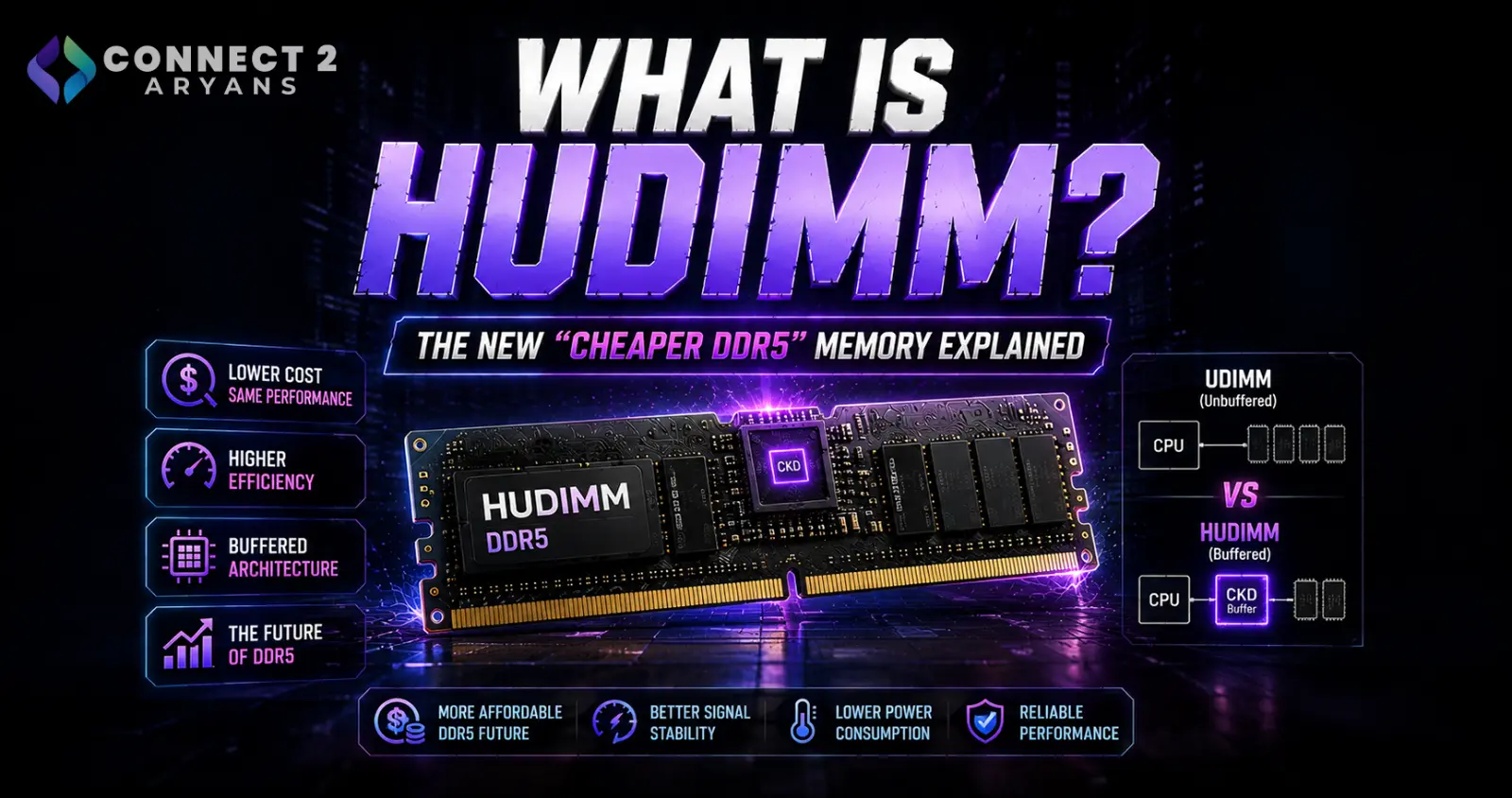
Facing sky-high DDR5 prices during the current memory shortage, ASRock introduced a new memory module design called HUDIMM specifically aimed at bringing costs down — but the way it achieves that lower price comes with a real, meaningful trade-off worth understanding before you consider it for a build.
What HUDIMM Actually Is
HUDIMM stands for Half Unbuffered DIMM. Standard DDR5 memory modules use two independent 32-bit sub-channels working together to deliver both capacity and bandwidth. HUDIMM modules use only one of those sub-channels — effectively cutting the module's bandwidth and density in half compared to a standard DDR5 stick, but also requiring roughly half the memory chips to manufacture, which is what brings the cost down.
Why This Exists
With DDR5 pricing surging dramatically through 2026 due to the broader memory shortage, ASRock developed HUDIMM specifically to give system builders — particularly those building budget and entry-level PCs — a lower-cost entry point into current DDR5 platforms during a period when standard DDR5 pricing has become a real barrier.
The Real Performance Trade-Off
Independent testing has found that a single HUDIMM module delivers roughly 50% lower memory throughput compared to a standard single DDR5 module — this isn't a minor compromise, it's a genuinely significant reduction in bandwidth.
The Mixed-Module Workaround
HUDIMM includes an interesting flexibility feature: it supports asymmetrical configurations where you pair a HUDIMM module with a standard UDIMM module. For example, combining an 8GB HUDIMM with a 16GB standard UDIMM creates a 24GB configuration that actually runs across three active 32-bit sub-channels (one from the HUDIMM, two from the standard module) — which manufacturer testing suggests can outperform a single standard 24GB module running on just two sub-channels.
This mixed approach is being positioned as a genuinely useful middle ground, offering better bandwidth than a pure HUDIMM setup while still costing less than an equivalent all-standard-DDR5 configuration.
Current Compatibility
- HUDIMM currently requires motherboard support via BIOS update — ASRock has enabled support across its Intel 600, 700, and 800-series boards, with GIGABYTE also rolling out BIOS support for its equivalent Intel motherboard lineup
- The technology is being developed in partnership with memory maker TeamGroup, with HUDIMM also planned in a compact HSODIMM form factor for laptops and small form-factor systems
- Support is currently concentrated on specific Intel motherboard platforms — check your specific motherboard model for confirmed HUDIMM support before planning around it
Is HUDIMM Worth Considering?
Where it makes sense:
- Genuinely budget-constrained builds where minimizing upfront RAM cost matters more than maximum performance
- Office, browsing, and light general-use PCs where the reduced bandwidth has minimal real-world impact
- Builds where you're specifically using the mixed HUDIMM + standard UDIMM configuration to balance cost and performance
Where it doesn't make sense:
- Gaming or performance-focused builds, where the roughly 50% bandwidth reduction of a pure HUDIMM configuration is a real, noticeable compromise
- Any build where you might want to upgrade RAM capacity later, since combining HUDIMM with future standard modules requires careful planning around the asymmetrical channel configuration
- Situations where you're not fully aware you're buying reduced-bandwidth memory — some industry commentary has raised concern that pre-built systems using HUDIMM may not clearly disclose this to average buyers, making it worth specifically checking module type before purchasing any suspiciously affordable DDR5-based pre-built PC
Our Take
HUDIMM is a genuine, functional response to a real problem — but it's a compromise technology born from a difficult memory market, not a free upgrade. For light-use, budget-focused builds, the trade-off may be entirely reasonable. For gaming or performance-sensitive builds, standard DDR5 (even at current elevated prices) remains the better choice, and it's worth specifically confirming module type before buying any unusually cheap DDR5-based system during this period.
Final Thoughts
HUDIMM offers a real way to reduce DDR5 costs during the current memory shortage, but it does so by genuinely halving bandwidth per module — not a trick or a free lunch. If you're shopping for budget memory or a budget pre-built PC right now, it's worth knowing this technology exists and specifically checking whether a suspiciously affordable listing is using it.
Browse our full range of Memory RAM on Connect2Aryans, and reach out to our team if you'd like help understanding what's actually inside a specific build before you buy, with warranty support included.