
Gigabyte GPU Prices Jump 20–40% in Japan: Could Graphics Cards Get Even More Expensive in 2026?
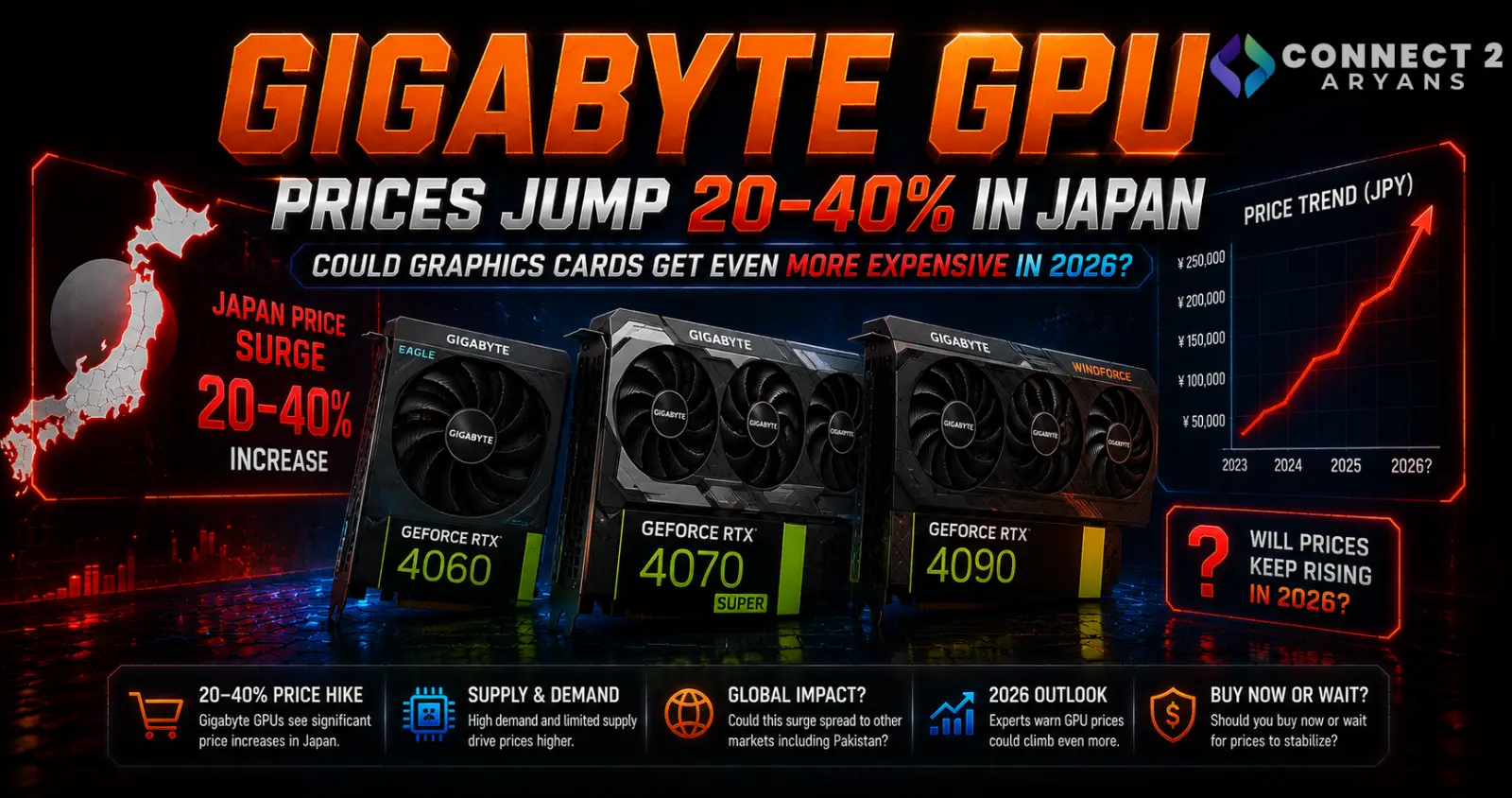
Gigabyte GPU Prices Jump 20–40% in Japan: Could Graphics Cards Get Even More Expensive in 2026?
Anyone waiting for graphics card prices to finally become more affordable in 2026 has just received another warning sign.
A Japanese distributor has announced a significant price revision affecting Gigabyte graphics cards, with new order prices reportedly increasing by approximately 20% to 40% starting August 1, 2026.
The change affects Gigabyte VGA products distributed by CFD Sales in Japan, and reports indicate that even some previously placed but unfulfilled wholesale orders could be affected.
The increase is currently specific to this Japanese distribution channel, so it would be incorrect to say Gigabyte graphics cards worldwide have suddenly become 40% more expensive.
However, the development arrives at a worrying time for PC gamers.
GPU prices are already under pressure from rising memory costs, AI-related semiconductor demand and increasingly expensive PC components.
For gamers and PC builders in Pakistan, the big question is obvious:
Could another global graphics card price increase be coming?
What Exactly Happened to Gigabyte GPU Prices?
Japanese distributor CFD Sales notified customers of revised pricing for Gigabyte graphics cards.
According to reports, new orders beginning August 1 are being priced at approximately 120% to 140% of previous levels, representing increases of roughly 20–40%.
This isn't necessarily a retail price increase of exactly 20–40% for every graphics card sitting on a store shelf.
The reported change concerns distributor ordering prices.
Retail pricing depends on several additional factors, including existing inventory, retailer margins and when stores need to purchase replacement stock.
But if distributors consistently pay more for new GPUs, those higher costs can eventually work their way toward consumers.
Some Existing GPU Orders Could Also Be Affected
One particularly unusual part of the story involves outstanding orders.
Reports indicate that certain previously placed orders that haven't yet shipped may need to be repriced or potentially cancelled because they can no longer be supplied under the original pricing arrangement.
That's significant because it shows how quickly conditions may be changing within the GPU supply chain.
Normally, buyers think of price increases as something affecting future stock.
In this case, the changes are severe enough that some unfulfilled orders may no longer be viable at their original prices.
Why Are Graphics Cards Getting More Expensive Again?
There isn't one simple explanation.
The PC hardware industry is currently dealing with several overlapping pressures, but memory pricing is one of the most important.
Modern graphics cards require dedicated video memory, and current-generation GPUs increasingly rely on high-performance memory technologies.
At the same time, the enormous expansion of artificial intelligence infrastructure has placed extraordinary demand on the broader semiconductor and memory industries.
AI data centers require massive quantities of:
- High-bandwidth memory
- Server DRAM
- AI accelerators
- Advanced semiconductor capacity
When demand increases faster than supply can respond, costs can rise across related markets.
The situation is therefore no longer only about how expensive the GPU chip itself is.
Memory has become another major factor affecting graphics card economics.
Both NVIDIA and AMD Graphics Cards Could Be Affected
This story isn't limited to one GPU architecture.
Gigabyte manufactures graphics cards using GPUs from both NVIDIA and AMD, meaning distributor-level changes can potentially affect GeForce and Radeon products.
Current gaming GPU families include NVIDIA's GeForce RTX 50 series and AMD's Radeon RX 9000 series.
That means gamers shouldn't assume switching from NVIDIA to AMD—or vice versa—automatically protects them from wider component-cost increases.
If the underlying issue involves memory, manufacturing and supply-chain costs, multiple GPU families can potentially be affected.
Browse the latest graphics cards available on Connect2Aryans and compare current NVIDIA and AMD GPU options before building or upgrading your gaming PC.
Why the 20–40% Figure Needs Context
A headline saying "GPU prices increase 40%" sounds dramatic.
But there's an important distinction.
The reported 20–40% increase applies to Gigabyte ordering prices through the Japanese distributor involved in this story.
It does not mean:
- Every Gigabyte GPU worldwide increased exactly 40%.
- Every retailer immediately increased prices by 40%.
- NVIDIA officially raised every GPU MSRP by 40%.
- AMD officially raised every GPU MSRP by 40%.
- Pakistani GPU prices will automatically rise by the same percentage.
Those claims would go beyond the available evidence.
What the report does provide is another indication that the cost pressure surrounding consumer graphics cards remains serious in the second half of 2026.
Could Other GPU Brands Increase Prices Too?
Possibly, but nothing should be assumed until further pricing changes are actually announced or observed.
Gigabyte isn't the only graphics card manufacturer buying GPUs, memory chips and other components from the same global semiconductor ecosystem.
Brands such as:
operate within many of the same broader market conditions.
If underlying GPU and memory costs continue rising, other board partners could face similar pressure.
But until specific increases are confirmed, it would be premature to say every brand will follow Gigabyte's reported Japanese pricing change.
What Could This Mean for GPU Prices in Pakistan?
Pakistan doesn't manufacture mainstream gaming graphics cards locally, meaning the market depends heavily on imported inventory.
That introduces additional variables including:
- International GPU prices
- USD/PKR exchange rate
- Import costs
- Freight expenses
- Distributor pricing
- Local inventory levels
- Retail competition
This can create a delay between an international price change and what Pakistani customers see in stores.
For example, a retailer may still have older inventory purchased before an international increase.
That stock can potentially remain available at the existing price.
Once it sells out, however, replacement inventory may arrive at a higher cost.
That's why international component-price movements matter even when the initial announcement comes from another country.
Old Stock vs New Stock Could Become Important
If GPU costs continue increasing, one of the most important things for buyers to understand is the difference between existing inventory and replacement inventory.
Imagine a retailer purchased a graphics card before a distributor increased its price.
That card doesn't magically become more expensive to the retailer.
But after it sells, replacing it may cost significantly more.
This can create a temporary period where the same GPU appears at very different prices between retailers depending on when their inventory was purchased.
We've seen similar behaviour across PC hardware markets during previous supply shortages.
For buyers, this means comparing prices becomes even more important when the market is changing quickly.
Should You Buy a Graphics Card Now?
Don't panic-buy a GPU simply because one distributor increased prices.
A graphics card is usually one of the most expensive components in a gaming PC, so the decision should still be based on:
- Your current GPU
- Target resolution
- Games you play
- Desired FPS
- Budget
- CPU compatibility
- Power supply
- Monitor refresh rate
However, if you're already planning to buy a specific GPU, waiting solely because you're expecting a major price reduction may now carry additional risk.
Current market signals aren't pointing uniformly toward cheaper hardware.
Instead, we're seeing pressure across several major PC components.
Don't Buy More GPU Than Your PC Can Use
Higher prices can create another psychological trap.
Buyers sometimes rush toward a more expensive GPU because they fear prices will rise again.
But buying the wrong graphics card at today's price isn't better than buying the correct one slightly later.
Before upgrading, consider your monitor.
You may not need an extremely high-end graphics card, particularly if you primarily play esports games.
1440p places significantly more demand on the GPU and can justify moving into higher performance tiers.
4K gaming requires substantially greater GPU performance, especially when targeting high refresh rates or enabling demanding visual settings.
Compare gaming monitors on Connect2Aryans when deciding which GPU performance level actually suits your display.
Check Your Power Supply Before Upgrading
Modern graphics cards can also have significantly different power requirements.
Before buying any GPU, check the manufacturer's official specification for:
- Recommended PSU capacity
- Required power connectors
- Card dimensions
- Power consumption
Don't assume your existing PSU will automatically support a new graphics card simply because the GPU physically fits your motherboard.
Browse power supplies on Connect2Aryans when planning a graphics card upgrade.
Could GPU Prices Keep Rising Through 2026?
Nobody can guarantee future retail pricing.
But the latest Gigabyte development adds another piece of evidence that the consumer GPU market remains under cost pressure.
Tom's Hardware reports that graphics card prices across Asia are facing further upward pressure, with the Japanese Gigabyte increase following other regional price movements.
The situation is particularly concerning because it overlaps with the ongoing memory-price crisis.
If video memory and other component costs remain elevated, graphics card manufacturers have less room to reduce prices while maintaining margins.
That doesn't guarantee another global GPU shortage.
But it does make the assumption that GPUs will simply become progressively cheaper throughout 2026 increasingly questionable.
What Should PC Builders Do?
If you're building a gaming PC during an unstable GPU market, focus on the complete system budget rather than one component.
Start with:
1. Target resolution
Decide whether you're building for 1080p, 1440p or 4K.
2. Target games
Competitive games and demanding AAA titles have very different GPU requirements.
3. Graphics card
Choose the performance level you actually need.
4. Processor
Select a CPU capable of supporting your GPU and workload.
5. Power supply
Make sure it meets the GPU manufacturer's requirements.
6. Monitor
There's little benefit in paying heavily for performance your display cannot meaningfully use.
7. Remaining components
Balance motherboard, RAM, SSD, cooling and case spending around the core performance hardware.
Compare available graphics cards on Connect2Aryans before finalizing your gaming PC build.
Frequently Asked Questions
Did Gigabyte increase GPU prices by 40%?
A Japanese distributor reported revised Gigabyte graphics card ordering prices of approximately 20–40% higher, effective for new orders from August 1, 2026. This doesn't mean every Gigabyte GPU worldwide has increased by exactly that amount.
Are NVIDIA GPUs becoming more expensive?
Some current-generation GPU prices have remained above launch MSRP in various markets, and recent reports indicate additional price pressure. Pricing varies significantly by GPU model, manufacturer and region.
Are AMD graphics cards affected?
The Japanese Gigabyte pricing report concerns Gigabyte VGA products, and Gigabyte produces both GeForce and Radeon graphics cards. The exact increase can vary by product and market.
Will GPU prices increase in Pakistan?
There is currently no evidence supporting a specific percentage increase for Pakistan based on this Japanese announcement alone. However, sustained increases in international replacement costs can eventually influence imported hardware markets.
Should I buy a GPU now or wait?
If you've already chosen a graphics card that meets your requirements and find it at a price you're comfortable paying, current market conditions provide less reason to assume waiting will automatically result in a cheaper purchase. Buyers who don't actually need an upgrade should still avoid panic-buying.
Conclusion
The reported 20–40% increase in Gigabyte graphics card ordering prices in Japan is another worrying development for PC gamers in 2026.
It doesn't mean graphics cards everywhere will immediately become 40% more expensive, and it certainly doesn't guarantee an identical increase in Pakistan.
But it does show that GPU pricing remains vulnerable.
Memory costs, AI-driven semiconductor demand and broader supply-chain pressures are creating an environment where manufacturers and distributors may find it increasingly difficult to maintain previous pricing.
For Pakistani PC builders, the best response isn't panic.
It's planning.
If you're already building or upgrading a gaming PC, compare available stock, determine exactly how much GPU performance you need, and consider the complete cost of your system rather than waiting indefinitely for a price drop that may or may not arrive.
Browse our full range of Graphics Cards on Connect2Aryans, with warranty support included.